
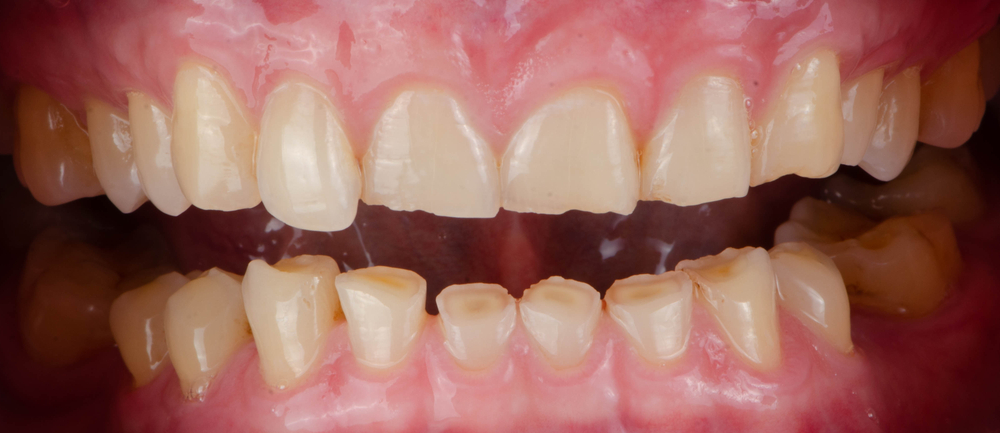
Principales señales y características clínicas
El bruxismo se manifiesta principalmente por:
- Desgaste dental (attrición): Pérdida del esmalte, facetas de desgaste y, en casos avanzados, exposición de la dentina (Prado et al., 2023; Đorđević et al., 2020; Şahin, 2024; Lobbezoo et al., 2018; Lobbezoo et al., 2013).
- Dolor o fatiga muscular: Dolor en los músculos masticatorios (masetero, temporal), especialmente al despertar o tras periodos de tensión (Şahin, 2024; Prado et al., 2023; Baad‐Hansen et al., 2019; Yoshida et al., 2017).
- Dolor en la articulación temporomandibular (ATM): Puede haber molestias, chasquidos o limitación de apertura bucal (Şahin, 2024; Đorđević et al., 2020; Baad‐Hansen et al., 2019).
- Cefaleas (dolor de cabeza): Frecuentes, sobre todo al despertar (Prado et al., 2023; Şahin, 2024; Storari et al., 2023).
- Impresiones en lengua o mejillas: Marcas de mordedura (indentaciones) en la lengua o la mucosa bucal (línea alba) (Prado et al., 2023; Lobbezoo et al., 2018; Şahin, 2024).
- Ruidos de rechinamiento: Percibidos por la pareja o familiares durante el sueño (Storari et al., 2023; Yoshida et al., 2017; De Oliveira et al., 2021).
- Fatiga mandibular o dificultad para abrir la boca: Sensación de rigidez o cansancio al masticar o al despertar (Şahin, 2024; Yoshida et al., 2017; Tăut et al., 2024).
- Hipertrofia muscular: Aumento del volumen de los músculos masticatorios por sobreuso (Prado et al., 2023; Lobbezoo et al., 2018; Tăut et al., 2024).
Factores asociados y diagnóstico
- El bruxismo puede estar relacionado con estrés, ansiedad, trastornos del sueño y factores psicosociales (Storari et al., 2023; Manfredini et al., 2017; Vlăduțu et al., 2022).
- El diagnóstico se basa en la combinación de auto-reporte, observación clínica y, en casos específicos, estudios instrumentales como electromiografía o polisomnografía (Storari et al., 2023; Lobbezoo et al., 2018; Şahin, 2024; De Oliveira et al., 2021).
- En niños, la observación de los padres y el examen clínico son fundamentales (Storari et al., 2023; Bulanda et al., 2021).
Tabla: Señales clínicas frecuentes de bruxismo
| Señal/Síntoma | Frecuencia/Importancia | Citaciones |
| Desgaste dental | Muy frecuente | (Prado et al., 2023; Đorđević et al., 2020; Şahin, 2024; Lobbezoo et al., 2018; Lobbezoo et al., 2013) |
| Dolor muscular | Frecuente | (Şahin, 2024; Prado et al., 2023; Baad‐Hansen et al., 2019; Yoshida et al., 2017) |
| Cefaleas | Frecuente | (Prado et al., 2023; Şahin, 2024; Storari et al., 2023) |
| Impresiones en lengua/mejilla | Frecuente | (Prado et al., 2023; Lobbezoo et al., 2018; Şahin, 2024) |
| Ruidos nocturnos | Frecuente | (Storari et al., 2023; Yoshida et al., 2017; De Oliveira et al., 2021) |
Figure 1: Principales señales clínicas de bruxismo y su frecuencia.
Conclusión
El bruxismo se caracteriza por una combinación de desgaste dental, dolor muscular, cefaleas y marcas en tejidos blandos, aunque la intensidad y combinación de síntomas varía entre individuos. El diagnóstico requiere evaluación clínica y, en ocasiones, apoyo instrumental.
References
Storari, M., Serri, M., Aprile, M., Denotti, G., & Viscuso, D. (2023). Bruxism in children: What do we know? Narrative Review of the current evidence.. European journal of paediatric dentistry, 24 3, 207-210. https://doi.org/10.23804/ejpd.2023.24.03.02
Baad‐Hansen, L., Thymi, M., Lobbezoo, F., & Svensson, P. (2019). To what extent is bruxism associated with musculoskeletal signs and symptoms? A systematic review.. Journal of oral rehabilitation. https://doi.org/10.1111/joor.12821
Bulanda, S., Ilczuk-Rypuła, D., Nitecka-Buchta, A., Nowak, Z., Baron, S., & Postek-Stefańska, L. (2021). Sleep Bruxism in Children: Etiology, Diagnosis, and Treatment—A Literature Review. International Journal of Environmental Research and Public Health, 18. https://doi.org/10.3390/ijerph18189544
Manfredini, D., Serra-Negra, J., Carboncini, F., & Lobbezoo, F. (2017). Current Concepts of Bruxism.. The International journal of prosthodontics, 30 5, 437–438. https://doi.org/10.11607/ijp.5210
Şahin, T. (2024). Bruxism awareness and self-assessment in dental clinical students: a questionnaire-based study. BMC Oral Health, 24. https://doi.org/10.1186/s12903-024-04997-x
Prado, I., Abreu, L., Pordeus, I., Amin, M., Paiva, S., & Serra-Negra, J. (2023). Diagnosis and prevalence of probable awake and sleep bruxism in adolescents: an exploratory analysis. Brazilian Dental Journal, 34, 9 – 24. https://doi.org/10.1590/0103-6440202305202
Đorđević, N., Todić, J., Lazic, D., Šehalić, M., Mitić, A., Radosavljević, R., Đorđević, A., & Subaric, L. (2020). Bruxism. Praxis medica. https://doi.org/10.5937/pramed2002029d
Lobbezoo, F., Ahlberg, J., Raphael, K., Wetselaar, P., Glaros, A., Kato, T., Santiago, V., Winocur, E., Laat, A., Leeuw, R., Koyano, K., Lavigne, G., Svensson, P., Svensson, P., & Manfredini, D. (2018). International consensus on the assessment of bruxism: Report of a work in progress. Journal of oral rehabilitation, 45, 837 – 844. https://doi.org/10.1111/joor.12663
Tăut, M., Chanteux, S., Kui, A., Buduru, R., Negucioiu, M., Manziuc, M., Gheorghiu, I., Hedeșiu, M., Buduru, S., & Ilea, A. (2024). Condylar Parameters and Mandibular Movement Patterns in Bruxers Using an Optical Jaw Tracking System. Journal of Clinical Medicine, 13. https://doi.org/10.3390/jcm13247761
Vlăduțu, D., Popescu, S., Mercuț, R., Ionescu, M., Scrieciu, M., Glodeanu, A., Stănuși, A., Rîcă, A., & Mercuț, V. (2022). Associations between Bruxism, Stress, and Manifestations of Temporomandibular Disorder in Young Students. International Journal of Environmental Research and Public Health, 19. https://doi.org/10.3390/ijerph19095415
De Oliveira, M., Almeida, A., Félix, S., Rua, J., Cebola, P., & Godinho, C. (2021). Sleep bruxism: the complexity of a definitive diagnosis – case report. Annals of Medicine, 53, S77 – S77. https://doi.org/10.1080/07853890.2021.1897389
Yoshida, Y., Suganuma, T., Takaba, M., Ono, Y., Abe, Y., Yoshizawa, S., Sakai, T., Yoshizawa, A., Nakamura, H., Kawana, F., & Baba, K. (2017). Association between patterns of jaw motor activity during sleep and clinical signs and symptoms of sleep bruxism. Journal of Sleep Research, 26. https://doi.org/10.1111/jsr.12481
Lobbezoo, F., Ahlberg, J., Glaros, A., Kato, T., Koyano, K., Lavigne, G., Leeuw, R., Manfredini, D., Svensson, P., & Winocur, E. (2013). Bruxism defined and graded: an international consensus.. Journal of oral rehabilitation, 40 1, 2-4. https://doi.org/10.1111/joor.12011